The Cunning Plan Comes to Fruition – Lisburn, 1977
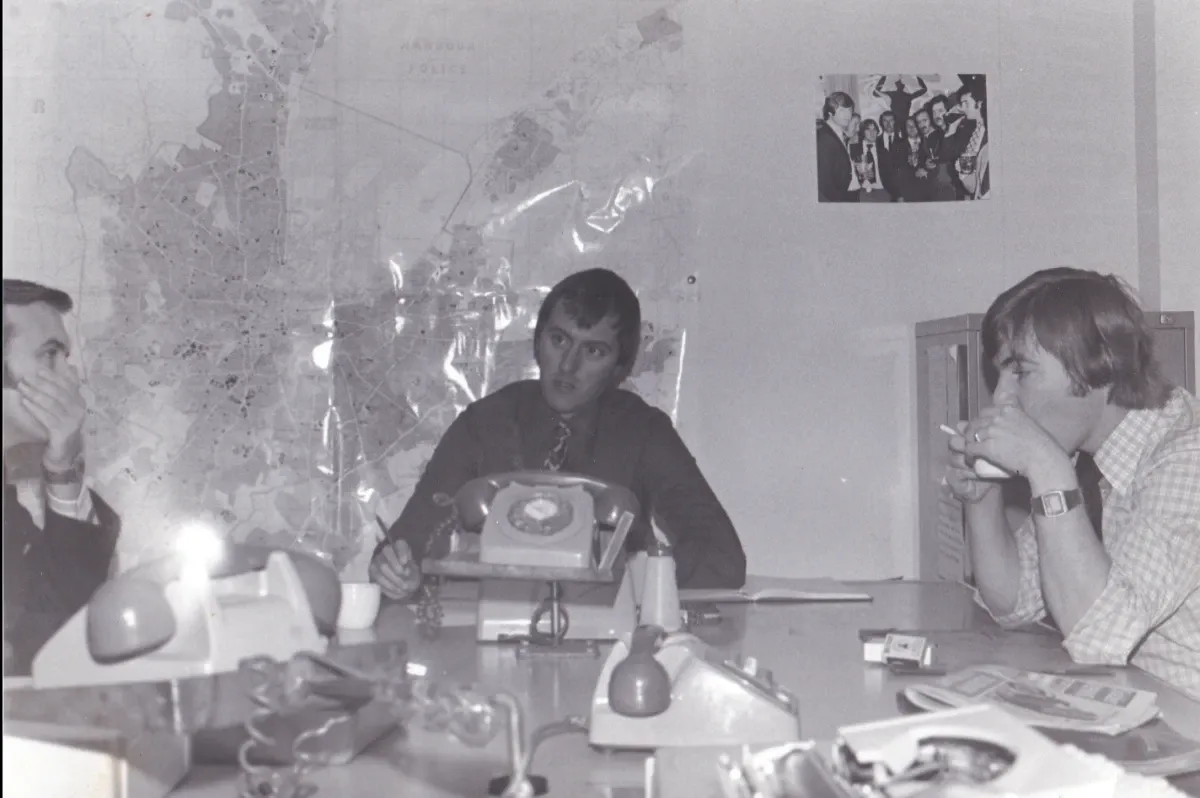
I'm on the right drinking coffee. The Criminal Investigations Office at 178 Provost Company, RMP.
My cunning plan had finally paid off.
After three years of hard graft, I’d managed to wangle my way into 178 Provost Company, RMP (Investigations), based at Thiepval Barracks. It was a 2 year posting and my aim was to be a Sergeant in the Special Investigation Branch by the end of it.
At the time, I thought it was a masterstroke. With hindsight, “cunning” might be overselling it. The reality was that I’d joined the RMP with the grand ambition of wearing civilian clothes, growing my hair, and pretending I was in The Sweeney.
Welcome to Thiepval Barracks
HQ Northern Ireland was also based at Thiepval, while 178 Pro Coy occupied the second floor of a prefab just across the road. Both buildings sat inside a fenced compound with a gatehouse, though whether anyone ever actually manned it is another question.
The camp itself was well-equipped. There were playing fields, gymnasium, running track, and even an indoor badminton and tennis court under a large dome. Married quarters were tucked inside the main fence.
The single men’s block was a different story. Six or eight blokes crammed into a room meant you quickly became familiar with your roommates’ snoring patterns, personal habits, and questionable taste in aftershave.
The Food: A Rare Victory
One genuine bright spot was the cookhouse.
The food was excellent, easily as good as, and often better than, many restaurants I’ve visited since. Proper fish and chips, fresh salmon, curries, and all sorts of meat dishes.
Sundays were particularly civilised. A brunch that ran all morning meant you didn’t have to crawl out of bed at some ungodly hour just to get fed.
The Work: Crime, Complaints, and Reality
If memory serves, the Company was split into two sections: criminal investigations and Complaints Against the Army. The latter existed because, apparently, soldiers occasionally upset the locals.
I was placed in investigations, while others were farmed out on attachment to CID offices at RUC stations, cheerfully labelled “RUC Support.”
Most of our bread and butter involved investigating crimes committed by soldiers against other soldiers. Squaddies being squaddies, there was never a shortage.
While our legal powers over civilians in Northern Ireland were technically broader, in practice, if a soldier was blown up or shot, the RUC took the lead. They had the resources, the sources, and a far better idea of who was trying to kill whom on any given day.
War Correspondents in Disguise
For major incidents involving deaths or serious injuries, caused by terrorist acts, our job was less Sherlock Holmes and more BBC News correspondent.
We gathered what information we could and wrote interim reports, which often formed the basis of whatever sanitised version HQ later fed to the press.
In those moments, we weren’t really investigators at all. Just glorified war correspondents with police powers.
The Comedy Department
The Complaints Against the Army lads had a different kind of entertainment.
The RUC would take complaints from civilians, and our blokes would interview the soldiers involved. Some of the claims were genuinely hilarious, including the legendary case of “The Nag That Became a Thoroughbred Racehorse”, which deserves its own story.
Training: Gas Chambers and Reality Checks
Within weeks of arriving, I was packed off to do the NIRTT course at Ballykinler and, I think, the Basic Investigations Course back at the Depot in Chichester.
NIRTT: How Not to Get Yourself Killed in Belfast
NIRTT, the Northern Ireland Reinforcement Training Team, existed to give you at least a fighting chance of staying alive.
If you hadn’t served there in the last 18 months, or were new to the place, you were going through it whether you liked it or not.
The premise was simple. Northern Ireland wasn’t Germany, where the biggest hazard was staying awake during yet another pointless NATO exercise. This was a place where people genuinely wanted to kill you, and they were endlessly inventive about it.
The course was essentially a crash course in survival. How not to walk into an ambush. How to read the warning signs. Why that innocent-looking milk churn might explode and kill you.
Much of it didn’t really apply to me. I wasn’t going to be patrolling the streets with a rifle and flak jacket. Still, I went through the motions, did mock patrols, got “killed” a few times, and occasionally survived.
My main issue was more practical. My bright red RMP beret kept falling off. We wore suits and ties to work and had been told to grow our hair before coming to Northern Ireland. Berets and long hair do not mix.
The standout memory was running half a mile in a gas mask, then being herded into a CS gas chamber while still panting. Off came the mask, and chaos followed. Coughing, streaming eyes, puking and the general loss of dignity, all to the amusement of the training staff.
The Briefings
The real “education” came during the briefings.
One Intelligence Corps chap gave us a talk about how stupid the “Paddies” were, recounting stories of them blowing themselves up with their own bombs or injuring each other with RPG back blasts.
It was classic dehumanisation. The same pattern: gooks, rag-heads, seen elsewhere, different conflict, same language.
At the time, I laughed along with everyone else.
Then the Warrenpoint ambush happened.
Suddenly, those jokes didn’t seem quite so funny.
Field Experience (Tick Box Exercise)
“Graduation” from NIRRT involved spending a few hours with a unit operating on the streets of Belfast.
I was sent somewhere on the Falls Road and attached to the Royal Highland Fusiliers.
I knew the RHF from my previous posting in Edinburgh and hoped they didn’t recognise me from any earlier encounters. These had probably involved me arresting one of them for being drunk and fighting.
The corporal in charge was clearly unimpressed at being handed what must have looked like a clueless spare part.
His first act was to remove my red beret and replace it with a glengarry.
Off we went.
I got to practise stop and search, and the first bloke I spoke to took one look at my hair and said, “You’re intelligence, right?”
That pretty much summed it up.
The corporal did his job, kept us out of trouble, and got us back safely.
Practical training complete.
Boxes ticked.
Full Circle
About a year later, I found myself back at Ballykinler.
This time as a member of staff.
I got to dress up as a soldier and still knew very little about infantry tactics, but that didn’t seem to matter. I improvised and got on with it.
I spent a month there, much of it learning how to build “booby-trap bombs” using thunderflash powder, detonators, masking tape, fishing line, and clothes pegs for our mock ambushes.
How the fuck I didn’t end up blowing my hands or face off, I will never know.
Health and safety wasn’t really a thing in the 1970s.